Rivalta is one reasoning engine running six domain
verticals — each itself a multi-agent system —
against a shared model of a household’s financial
life. Every analysis already reasons across tax, estate,
insurance, and real estate, because at $5M+ the domains
don’t sit still while you work one of them. Concord is
the deeper pass: it convenes every specialist that applies
to the household and forces them to resolve where they
disagree. The comparisons are public.
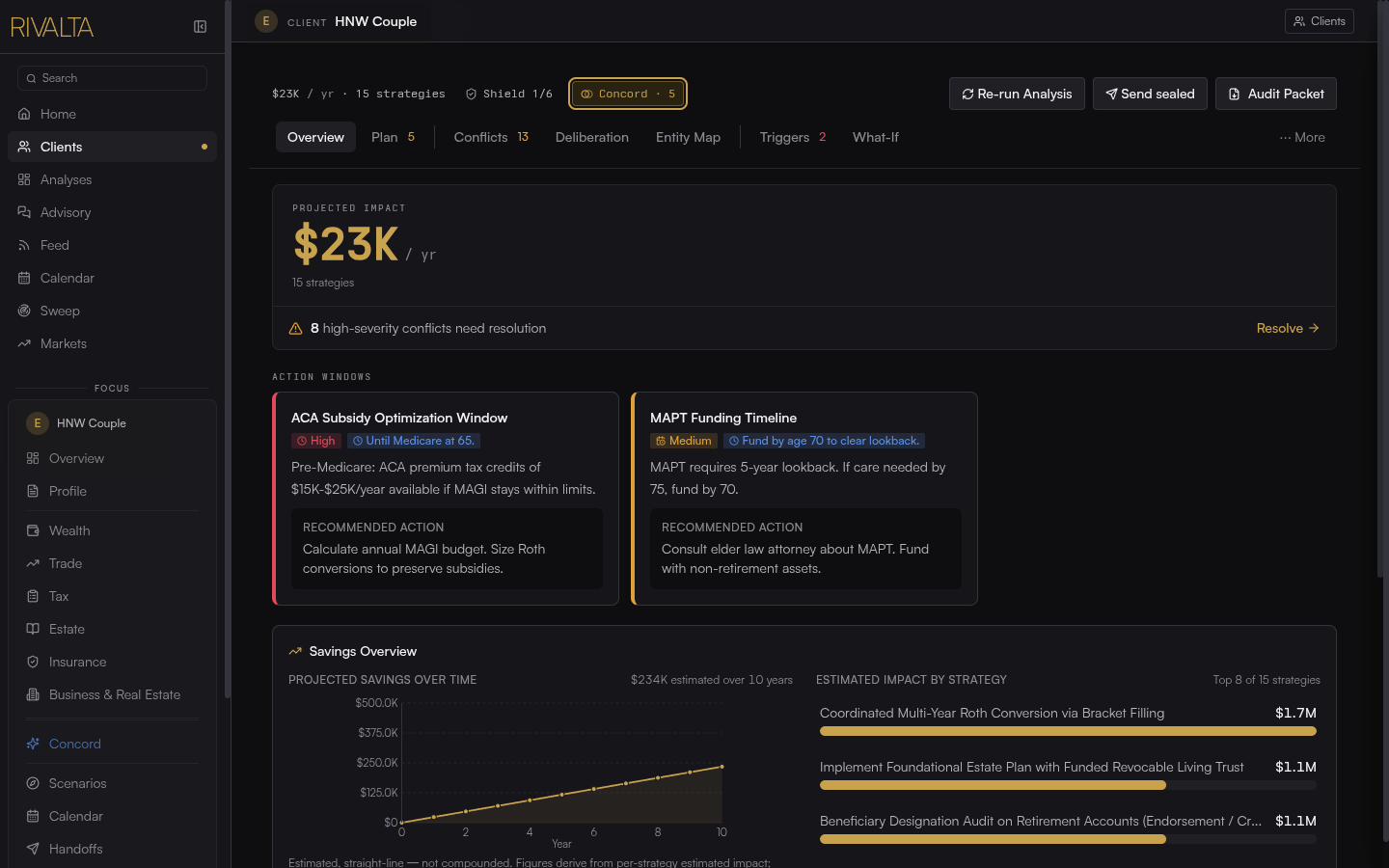
One run, one screen: projected impact, the conflicts ranked by severity, and the windows that close on a calendar. Live product, staging data.
Wealth.
The hub of the financial cluster. Portfolio construction, retirement income, decumulation sequencing, asset allocation against illiquid holdings, Roth conversion strategy. Ten specialist agents reasoning end-to-end against the household's actual position — not a planning framework's idealized position, the actual one with the rental property, the deferred compensation cliff, the concentrated stock, and the spouse's unvested options.
The vertical models tax interactions natively. It does not propose a Roth conversion sequence and hand it to the tax vertical for a sanity check; it models the conversion sequence as a tax-shifting operation against the household's current and projected brackets, and the recommendation arrives with the federal and state numbers already attached.
// IRC §408A(d)
Tax.
Proactive, not reactive. Eight specialist agents that model how every other domain's decisions land in the household's tax position — federal, state, AMT, NIIT, state-level estate, generation-skipping transfer. The vertical does not produce a return; it produces a strategy and a timeline.
The forcing function is plan drift. The law changed underneath the books: OBBBA made the estate exemption permanent at $15M single, $30M married. Plans engineered for a sunset that never came are now mis-sized to assumptions that no longer hold — over-funded bypass trusts, ILITs whose liquidity rationale is moot, gifting strategies calibrated to a window that closed in the other direction. That inventory of misfit plans sits, undiscovered, in advisor books. The Tax vertical surfaces the drift and quantifies the remediation.
// IRC §2010(c)
Estate.
Eight specialist agents covering succession, intergenerational transfer, GST, trust titling, post-sunset re-funding, and the post-Loper Bright (2024) ambiguity that increased the cost of relying on Treasury guidance without supporting case law.
The vertical's distinctive move is sequencing. It does not produce a list of estate strategies the household could pursue; it produces a sequence with the dependencies modeled explicitly. Fund the ILIT before the GRAT. Re-paper the buy-sell before the entity restructure. The order matters, and the order is what generic estate-planning cannot produce.
// IRC §2056
Insurance.
Coverage adequacy, premium financing, asset protection, cross-vertical coordination of the kind that prevents Connelly v. United States (2024) — the SCOTUS ruling that inflated estate-tax bills for closely held businesses whose buy-sell agreements were funded with corporate-owned life insurance.
Eight specialist agents that reason against the actual policies in force, the actual buy-sell language, and the actual entity structure. Most insurance recommendations in the market are produced by people whose primary discipline is selling insurance. Rivalta's recommendations are produced by an engine that has no incentive to sell.
// IRC §2042
Trade.
Seven specialist agents producing regime-aware execution context and market-signal awareness against the household's actual position. The vertical that connects the wealth strategy to the day's market state — not as a recommendation to trade, but as an awareness layer that flags when a recommended action (a charitable transfer, a tax-loss harvest, a concentrated-position diversification) intersects with current market conditions.
Trade does not produce orders. It produces context. The household's other professionals decide what to do with the context. This is the vertical most often misunderstood by buyers who assume "trade" means "active trading" — it means the trading-floor's awareness of how the rest of the household's life is moving against the day.
// Reg. §1.1091-1
Business & Real Estate.
Nine specialist agents covering entity structuring, rental property economics, depreciation strategy, 1031 timing, opportunity-zone interactions, and exit planning. The vertical that operates closest to the cash flow of the household's actual income-producing assets.
Distinctive in three places. Cost-segregation modeling against the actual depreciation schedule. Entity-restructure proposals that pre-quantify the estate-tax consequence — the kind of coordination most CPAs cannot do because they don't carry the estate side. Pre-exit planning that runs against the buy-sell, the QSBS clock, and the F-reorganization landscape at the same time.
// IRC §1031, §1202
One synthesis.
Each vertical — itself a system of specialist agents
— produces a finished, end-to-end recommendation on a
shared model of the household. They disagree. The Wealth
vertical’s optimal Roth conversion sequence inflates
AGI past the ACA cliff that the Tax vertical was modeling
against. The Estate vertical’s optimal GRAT funding
schedule depletes the cash position that the Insurance
vertical needs for premium financing. The Business
vertical’s optimal entity restructure changes the
basis that the Wealth vertical was modeling against.
A great advisor knows enough tax, estate, and
insurance to factor them in — one mind, broad
knowledge. Concord is putting the CPA, the estate attorney,
the fee-only planner, and the insurance strategist in a room,
letting each see the others’ final recommendations, and
making them resolve where they disagree. Not the same
answer, faster — a categorically different deliverable.
Minutes, not weeks.
What arrives at the end is a dossier — one coherent
recommendation set with the tradeoffs already resolved, and
what you hand the client, under your own name and license.
Panel-grade
coordination the client can hold: the resolution and the
dissent on the same page. The dissent is not noise to be
filtered; it is the record of the decisions the engine made
on the household’s behalf, and the basis on which a
fiduciary defends those decisions if questioned.
// Concord — cross-vertical reconciliation
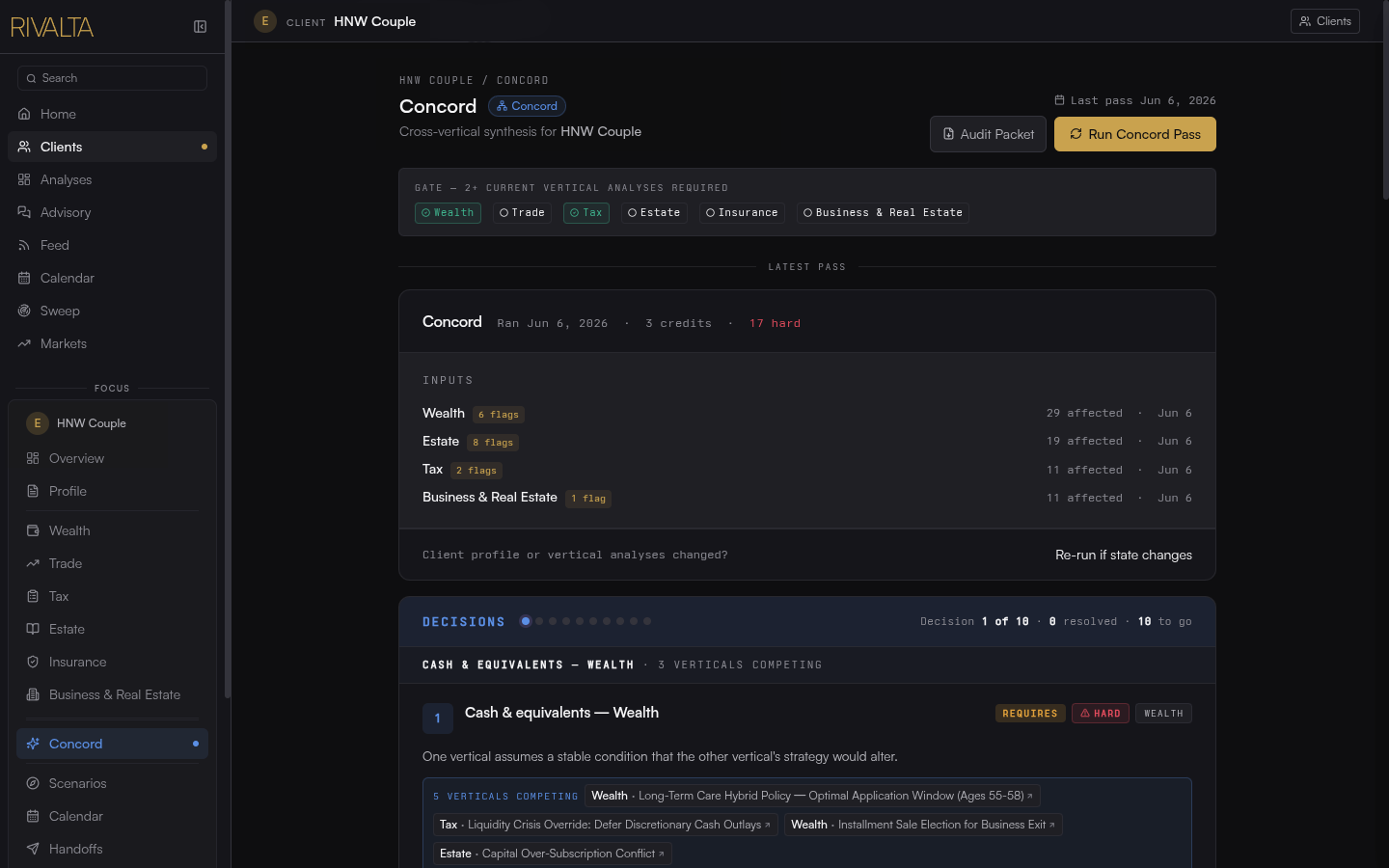
Every vertical that applies to the household, at one gate — with the decisions where they compete resolved and named. Live product, staging data.
For a single analysis, the professional picks the leading vertical. For Concord, the engine determines which of your verticals apply to that household and convenes only those — one client may pull Business & Real Estate, Tax, and Estate; another Wealth, Insurance, and Trade. The applicable set is shown before the pass begins.
Do I have to buy all six verticals?
No — all six (Wealth, Tax, Estate, Insurance, Trade, and Business & Real Estate) are included with every seat at both tiers. The tier sets your credit allowance, not which domains you can run. You run whichever verticals fit each client; there are no per-vertical add-ons.
How is client privacy protected?
The client's identity never reaches the engine. The professional enters a pseudonym at intake, and document parsing and the scrub of names, account numbers, and addresses happen in the browser before any structured data leaves the device. The engine stores only a synthetic ID and the financial figures; the real-name map stays in the professional's browser, and Rivalta holds no copy.
Does Rivalta replace my CPA, attorney, or other advisors?
No. Rivalta gives the verified professional a coordinated, cross-domain view and stress-tests what the rest of the stack produced; it does not advise clients or execute transactions. The professional reviews the output, applies judgment, and delivers the recommendations under their own license and relationship. A CPA, an estate attorney, and a wealth advisor each bring their own responsibility to the advice they sign.
What do I receive, and what do I hand the client?
You receive one coordinated recommendation set — sequenced plan items with primary-source citations, every detected conflict with its quantified tradeoff and resolution options, and every rejected alternative with the reason it was set aside. From the set you accept, you generate the client-facing dossier the professional packages and hands to the client. The dissent stays on the record beside the resolution.