01 / Wealth
Wealth strategy
Portfolio, retirement-income, decumulation, asset allocation against illiquid holdings, bracket-managed Roth conversion sequencing. The hub of the financial cluster.
A CPA, an estate attorney, a fee-only planner, an insurance broker, and a real-estate professional sitting in a conference room produce the kind of recommendation an HNW household actually needs. They take three weeks to do it. Rivalta is the engine that produces the same kind of recommendation in minutes, not weeks — the deliverable you hand the client, under your own name and license. This page describes the architecture by what it does, not how it does it.
Each specialist is bounded by its domain — its case law, its regulatory state, its calculation surface. None of them sees the household alone. They reason against one shared model of the household and surface their recommendations to an orchestrator that holds the cross-domain picture.
01 / Wealth
Portfolio, retirement-income, decumulation, asset allocation against illiquid holdings, bracket-managed Roth conversion sequencing. The hub of the financial cluster.
02 / Tax
Proactive, not reactive. Models how every other domain's decisions land in a tax position. Bracket math, IRMAA, AMT, QBI, basis tracking, current statutes and case law.
03 / Estate
Succession, intergenerational transfer, GST, trust titling, and the drift OBBBA left behind — bypass trusts over-funded for a sunset that never came, ILITs whose liquidity rationale is now moot. Reads current case law, including the consequences Connelly v. United States created.
04 / Insurance
Coverage adequacy, premium financing, asset protection, and the coordination across domains that prevents Connelly-class outcomes. Models LTC, life, and asset-protection structures.
05 / Trade
Regime-aware, multi-strategy, risk-managed. Reads concentrated positions, option books, and RSU stacks against the household's wealth plan. Fires only when there is an active trading surface to reason about.
06 / Business & Real Estate
Entity structuring, rental property economics, depreciation, §1031 timing, buy-sell coordination, exit planning. The vertical that touches the most other verticals on any given household.
A full analysis runs each active vertical end-to-end against one shared set of facts, then Concord reconciles the finished plans. The Tax specialist sees the Wealth specialist’s Roth conversion sequence; the Insurance specialist sees the Estate specialist’s ILIT funding schedule. Where two disagree, the orchestrator quantifies the dollar tradeoff and presents one resolved recommendation with the dissent visible. The deliverable is what you hand the client, under your own name — the kind of synthesis that today only exists when five professionals sit in a room for three weeks.
Specialist attribution
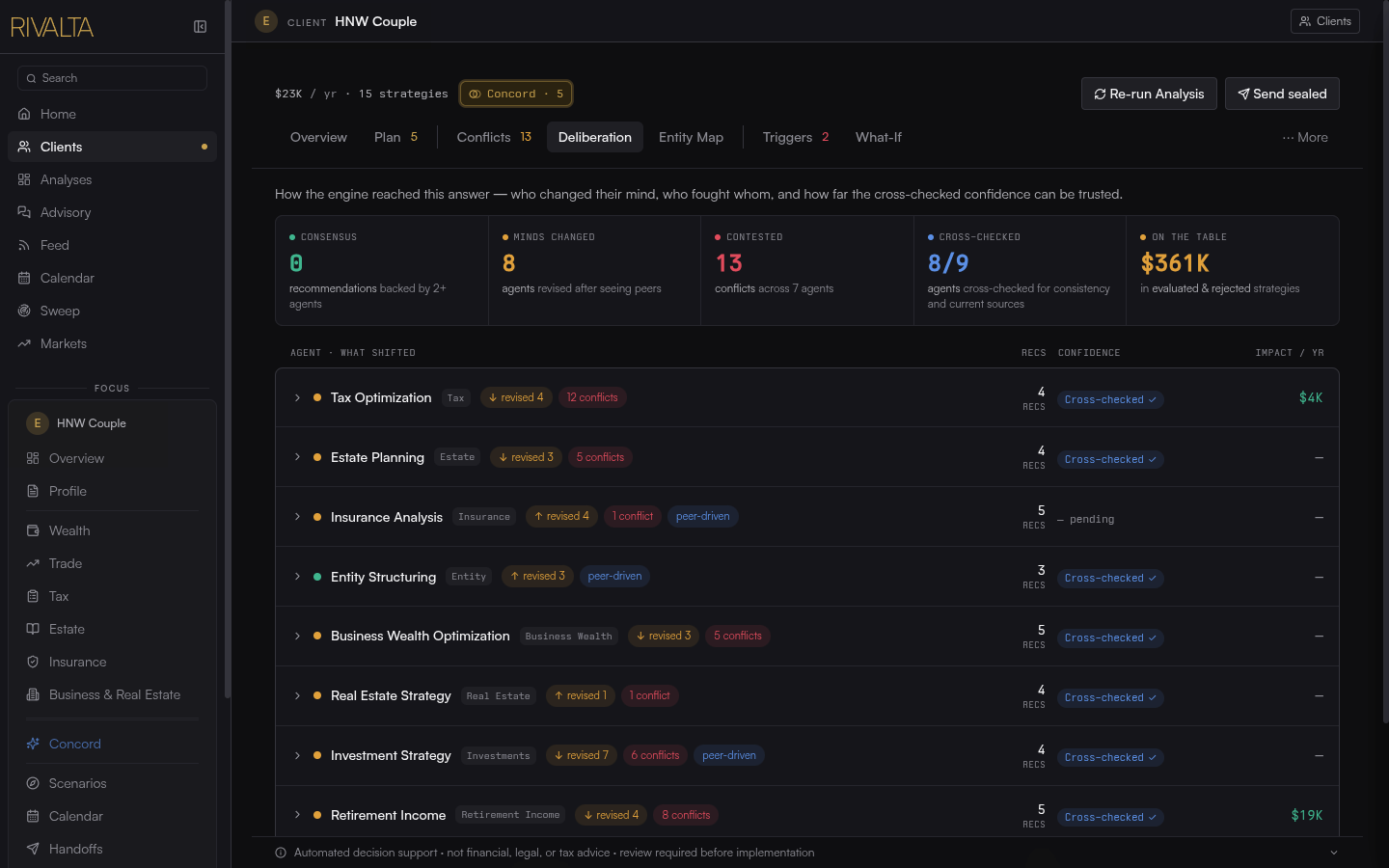
Concord is the second pass — the one that runs above the verticals. It fires once two or more verticals are active and each has finished its own analysis, and it takes their completed plans as input. It propagates constraints across the active verticals in rounds, lets each plan be re-read against the others’ final positions, re-resolves the conflicts to convergence, and quantifies the dollar value attributable to the coordination itself. Two verticals or five, Concord reconciles the ones in play — not a fixed set.
Before a Concord pass runs, a lightweight scout reads whether the active verticals are even in tension — weak, moderate, or strong. If there’s nothing to reconcile, you’ll know before you spend anything on the pass.
// STEP 01
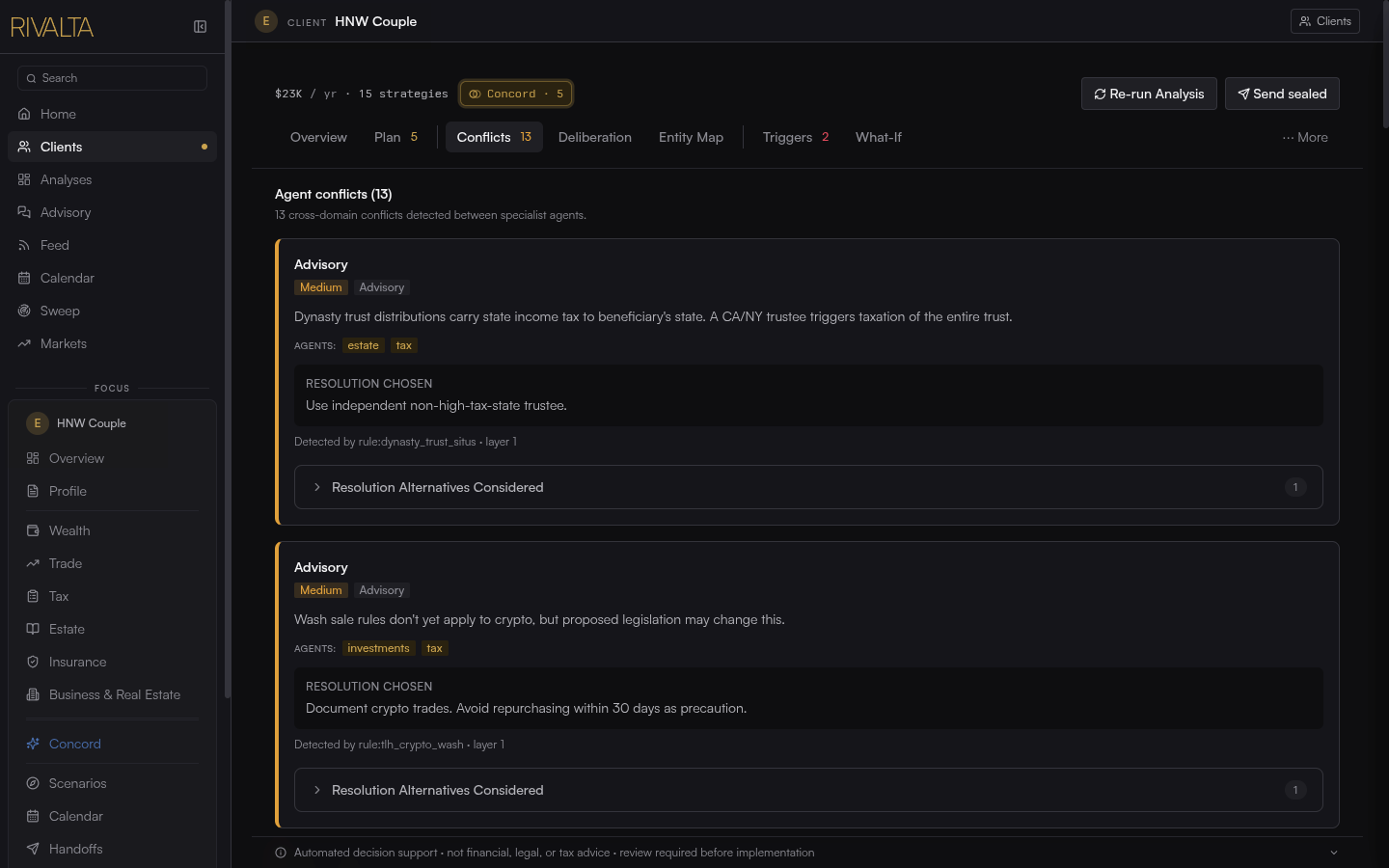
Each vertical's recommendations are read against the others. The engine surfaces every conflict where two domains move the same lever — the Roth conversion against the LTC premium funding, the §121 exclusion against the LLC contribution, the 529 superfunding against the ACA premium subsidy ceiling.
// STEP 02
For each conflict the engine generates three to five structured options — who acts, what tradeoff is locked in, what becomes reversible later. The professional picks the option. Nothing executes silently.
// STEP 03
The pick spawns a real recommendation on the chosen vertical's plan, then a deterministic second-order pass reruns the cross-domain detector so the professional sees which other conflicts the pick just resolved — and which it just promoted.
Concord is the capability that single-domain tools physically cannot replicate by sitting inside one domain. It requires the shared entity graph, the parallel specialist reasoning, and the orchestrator that holds the cross-domain picture. It is one of the eleven patent-pending claims listed below.
Each published comparison runs one vertical against its same-domain competitor — IncomeLab on Wealth, Holistiplan on Tax, and Vanilla on Estate. That is a single specialist’s pass, not Concord. Concord only has something to reconcile once two or more of those verticals run on the same household — the one thing a single-competitor comparison can’t stage. Each comparison names the five verticals that sat out, and points to the Concord pass that would run above them.
Conflicts, detected
Rivalta runs every analysis without ever seeing the client’s real identity. The reasoning engine consumes synthetic identifiers, raw numbers, and role labels. Real names live exclusively on the professional’s machine; they never reach Rivalta’s servers and never enter the reasoning passes at all.
This is an architectural property, not a privacy policy. The data model the engine sees is structurally insufficient to constitute a household-identifying record. The breach blast radius is dramatically narrower than the wealth-tech default, and the compliance conversation with a firm’s CCO begins from a different starting line. The anonymization architecture is one of the eleven patent-pending claims.
Provisional application 64/062,916, filed with the USPTO on May 11, 2026, assigned to Rivalta. Each claim covers a distinct capability of the engine. Each is described below by capability and outcome.
CLAIM 01
The orchestrator reads each specialist's recommendations as a set of moves with prerequisites — moves that must precede or follow other moves for regulatory or arithmetic reasons. It produces a sequenced execution plan that respects every ordering constraint, surfaces every constraint that two verticals impose on the same move, and refuses to silently violate one.
CLAIM 02
When two specialists disagree, the engine quantifies the dollar tradeoff between their proposals and resolves to a single recommendation — with the dissenting position preserved and visible. A fiduciary can sign the resolution because the road not taken is on the record.
CLAIM 03
All six specialists reason against one model of the household — every LLC, trust, property, beneficiary, premium, basis, election, and pending statute. No specialist works on a partial picture. A change at the household level propagates to every specialist's reasoning in the next pass.
CLAIM 04
When tax law, case law, or a regulatory boundary changes — and when a household's underlying facts cross a calendar boundary — the engine re-evaluates every affected household automatically. Findings surface to the professional before the client meeting, not after.
CLAIM 05
Concord runs above the active verticals: it propagates constraints across them in rounds, lets each completed plan see the others' final positions, and re-resolves to convergence — producing a single coherent recommendation across the domains in play, with every conflict between domains surfaced as a first-class artifact.
CLAIM 06
Each finding traces to a specific fact in the entity graph, a specific regulatory citation or case-law reference, and a specific reasoning step in a specialist's chain. The chain is auditable end-to-end. A compliance officer can ask why a recommendation exists and read the answer.
CLAIM 07
Each specialist reasons against a structured causal graph of household financial mechanics — depreciation schedules, basis tracking, beneficiary cascades, premium-payment economics. The graph carries the relationships that must hold exactly; open-ended reasoning handles what the graph cannot enumerate. The outcome is a recommendation grounded in the household's real mechanics, not a free-form guess at them.
CLAIM 08
Specialists are calibrated against each other's recommendations in adversarial pairs, so each learns where its recommendation will conflict before it reaches the orchestrator — specialists accountable to the cross-domain picture, not only to their own domain. This runs live today on the Trade specialist and is graduating across the other domains in stages.
CLAIM 09
A layer above the specialists that watches their reasoning chains for known failure modes — bracket-edge misapplication, jurisdictional confusion, citation drift, sequencing errors. When a chain enters a failure-prone region, the supervisor flags it for the specialist to retry against tighter constraints.
CLAIM 10
The engine maintains a household-scoped memory of which recommendations were accepted, which were deferred, and which were rejected and why. The next analysis on the same household reads the memory; recommendations the professional has explicitly rejected are not re-surfaced without new evidence.
CLAIM 11
For each recommendation, the engine surfaces the alternatives it considered and rejected, with the quantified reason for each rejection. The professional sees not only what to do but what the engine considered doing and discarded. Transparency that is patent-claim-relevant and that single-domain tools structurally do not produce.
The portfolio breadth is the message. Eleven claims across sequencing, conflict resolution, the entity graph, proactive triggers, Concord, causal attribution, the hybrid causal graph, adversarial self-play, reasoning supervision, calibrated memory, and behavioral-bias counterfactuals. A reproducing engine would need to clear every one. A retrofit on a single-domain tool clears none of them.
A general-purpose system answers one question at a time. Ask it about the Roth conversion and it answers about the Roth conversion. It does not, in the same breath, hold the LTC premium funding, the §121 exclusion, the trust titling, and the depreciation schedule alongside it — and it degrades exactly where those domains interact, which is precisely where an HNW household’s hardest decisions live. One general answer over six interacting domains is the place these decisions go wrong.
Rivalta is built the opposite way. Each specialist is scoped to one domain and one body of law, so its tax knowledge never bleeds into its estate reasoning. The six are then forced to argue: where two recommendations move the same lever, the engine quantifies the dollar tradeoff and reconciles to a single recommendation — on the record, with the dissenting position preserved. Specialization keeps each pass deep; orchestration makes the six cohere. The output is a dossier the advisor hands the client and a documented, reasoned resolution behind every line of it.
That record is the point. A regulator judges the process, not the outcome — whether the recommendation was reached through sound, documented reasoning. The reconciliation Rivalta writes down, conflict by conflict, road-not-taken by road-not-taken, is that defense made standing.
The comparisons show one of the six specialist verticals running against published competitor samples on the same inputs. The sandbox lets you run one of the six on a plan you already have — redacted, on your terms — and keep the dossier it produces.
The Concord pass runs each applicable vertical's finished plan against the others, then surfaces every place two domains move the same lever — with the dollar size of the tradeoff attached. For each conflict it generates three to five resolution options; the professional picks one, the choice is recorded, and a second pass rechecks what that pick resolved or promoted. Nothing resolves silently.
A specialist is one bounded analysis pass inside a vertical — scoped to its own statutes, case law, and calculations. Wealth convenes ten, Tax eight, Estate eight, Insurance eight, Trade seven, and Business & Real Estate nine. None sees the household alone; each reasons against one shared model and surfaces its recommendations to the orchestrator that holds the cross-domain picture.
A single conversational pass applies one line of reasoning across every domain. Rivalta convenes separate specialist panels against one shared household model, enforces the regulatory order in which steps must happen, detects and dollar-quantifies the conflicts between their outputs, and preserves every rejected alternative with the reason it was set aside. The result is an auditable deliverable, not an unexamined summary.
Every recommendation is broken into atomic claims routed to type-specific checks: numeric re-derivation against the platform's own calculators, two-step citation-and-content verification against the actual statute or regulation, and adversarial prove/disprove cycles on high-stakes claims. Findings are triaged red, yellow, and green for the professional, who remains the final reviewer. The full record of alternatives and verdicts is kept for every run.
A single-vertical analysis returns in minutes, with its sequenced recommendations, conflicts, rejected alternatives, and citations. The deeper Concord reconciliation also completes in minutes. The comparison is not a faster version of the manual process — it is a reconciled deliverable produced in one session, where assembling and reconciling a live panel of specialists takes weeks.
Patent status. Provisional application 64/062,916 filed with the United States Patent and Trademark Office on May 11, 2026. Assigned to Rivalta. Eleven claims described above by capability and outcome; the mechanism specifications are held under the utility-conversion window through May 11, 2027. Filed through Anthony Fussner of Polsinelli.
Privacy claim. The architectural property described under “Architectural privacy” is a property of the engine’s deployment, not of a configuration toggle. Rivalta cannot see the real identity of any client analyzed through the platform. The detail is part of the patent-pending portfolio and is described here only by outcome.
Disclosure. “Patent pending” describes the status of the eleven claims listed above. Patent grant is not guaranteed and depends on examiner review during the utility-conversion process. Rivalta makes no claim of issued patent.